

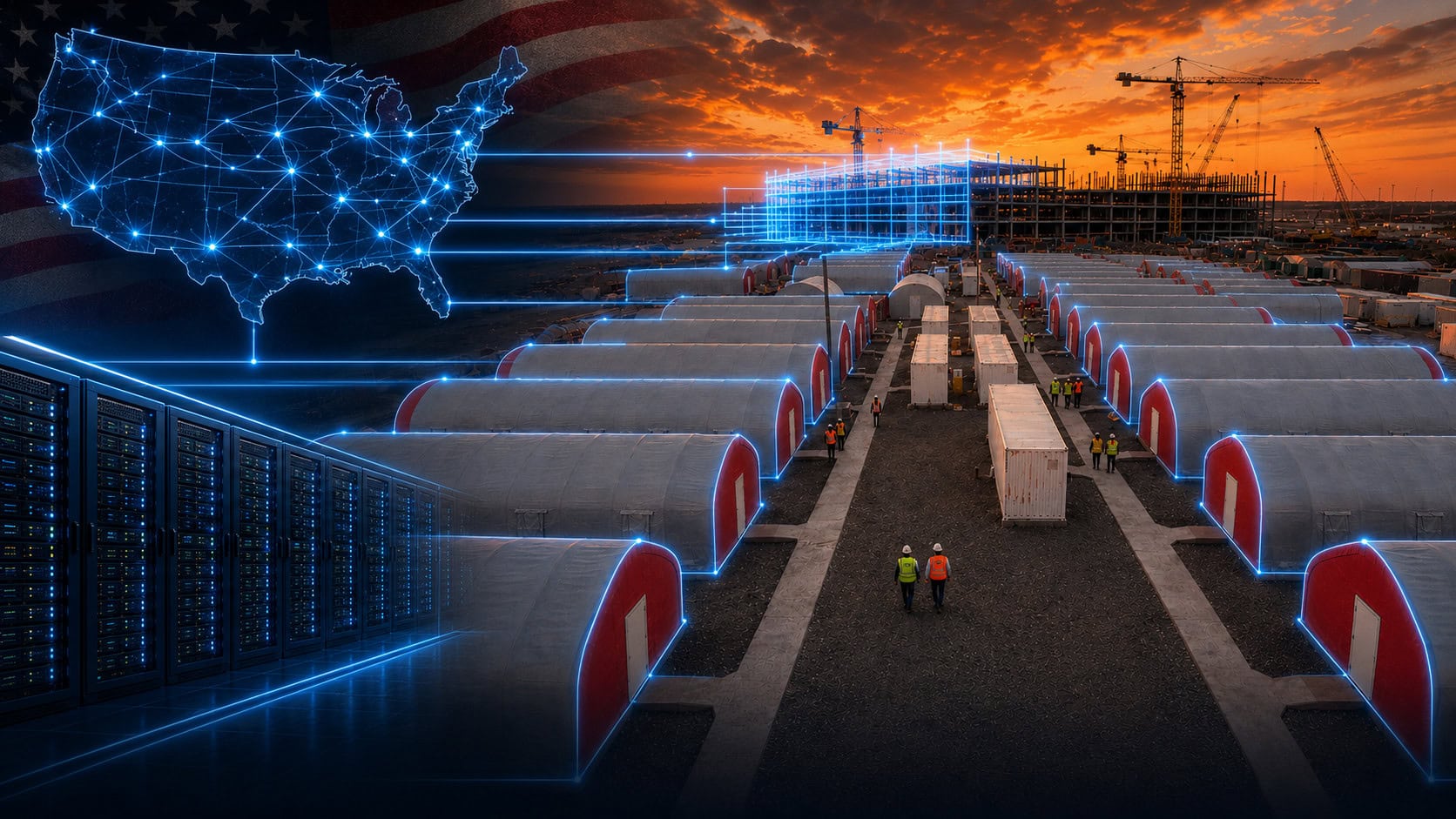
The rapid expansion of artificial intelligence, cloud computing, and digital infrastructure is fueling one of the largest construction booms in modern history: hyperscale data centers. Across the United States, billions of dollars are being invested in new facilities, creating unprecedented demand for the power, land, infrastructure, and skilled labor required to build them. As these projects accelerate, a critical challenge has emerged:
Where will the workforce live?
Large-scale data center construction projects often require hundreds to thousands of highly skilled workers, including electricians, HVAC technicians, welders, plumbers, concrete specialists, steel erectors, fiber installers, commissioning teams, and project managers. Many new data centers are being built in rural or semi-rural markets where access to large power capacity, lower land costs, and attractive economic incentives support large-scale development. However, these same locations often lack the housing infrastructure needed to accommodate hundreds or thousands of construction workers.
This workforce housing gap has become one of the most significant bottlenecks in maintaining schedule certainty for data center construction.
Recent media coverage has highlighted public concern surrounding large temporary workforce housing developments, sometimes labeled “AI man camps,” near major data center projects, particularly in fast-growing markets such as Wyoming and Texas. Community concerns often include housing pressure, traffic, environmental impact, and long-term land use. These concerns are valid and underscore an important reality:
Temporary workforce housing must be designed thoughtfully and professionally, with minimal impact on surrounding communities.
That is where Alaska Structures® provides a fundamentally different solution.
OVER 50 YEARS OF EXPERIENCE SUPPORTING REMOTE WORKFORCE OPERATIONS
For more than 50 years, Alaska Structures® has designed and delivered rapidly deployable building solutions for remote workforce operations worldwide.
We have long-standing relationships with major organizations across the following industries:
- Construction
- Mining
- Oil and gas
- Utilities and power generation
- Infrastructure development
- Government and defense
Our team works closely with project owners, construction managers, engineering and architecture firms, EPCM firms, workforce housing providers, and procurement and logistics teams to develop tailored temporary building solutions that support every phase of major construction projects.
For data center developments, this includes far more than sleeping quarters.
Alaska Structures® can support complete workforce communities by providing facilities for:
- Temporary workforce housing
- Kitchens and food service facilities
- Dining and mess halls
- Restrooms, showers, and hygiene facilities
- Laundry facilities
- Recreation and fitness spaces
- Sports and wellness facilities
- Project offices and meeting spaces
- Medical and first-aid facilities
- Security screening and access control
- Laydown yards and covered staging areas
- Bulk material storage facilities
- Equipment maintenance facilities
This enables developers and contractors to establish self-contained temporary workforce communities designed to support productivity, worker well-being, and schedule certainty while minimizing strain on local housing and community resources.
THE DATA CENTER LABOR CHALLENGE IS GROWING
Data center construction is increasingly constrained by labor availability.
Industry analysts estimate that nearly 300,000 construction workers may be required to support data center projects in 2026 alone, representing a substantial portion of net new construction labor demand.
At the same time:
- AI-driven infrastructure demand is accelerating
- Power and utility upgrades are increasing project complexity
- Skilled trade shortages are worsening
- Competition for qualified workers is intensifying
Companies building data centers can no longer assume labor will be sourced locally.
Instead, they must attract specialized workers from across the country.
That means housing becomes a strategic requirement, not a secondary logistical issue.
Without sufficient workforce accommodations, projects face:
- Labor shortages
- Increased wage pressure
- Schedule delays
- Productivity losses
- Higher turnover
WHY TRADITIONAL CONTAINER-BASED CAMPS ARE NOT ALWAYS THE BEST SOLUTION
Many temporary workforce housing providers rely heavily on modular buildings.
Container-based solutions can work well in certain applications, especially when permanent utilities and rigid floorplans are acceptable.
However, large-scale data center construction presents unique requirements:
- Rapid schedule compression
- Frequent scope changes
- Variable workforce counts
- Phased expansion needs
- Temporary occupancy windows
- Eventual demobilization and relocation
These conditions often expose limitations in rigid modular systems.
Common challenges include:
- Higher shipping weight
- More truckloads
- Limited open interior layouts
- Slower scaling for communal spaces
- Higher site preparation requirements (and costs)
- More permanent site impact
For temporary workforce communities supporting large-scale data center construction projects, flexibility is essential.
WHY ENGINEERED FABRIC BUILDINGS OFFER A BETTER ALTERNATIVE
Engineered fabric buildings from Alaska Structures® offer a highly efficient alternative to conventional temporary construction methods.
When evaluated against rigid modular systems using key project criteria such as deployment speed, expansion flexibility, transportation efficiency, and environmental impact, engineered fabric buildings often provide meaningful advantages for workforce housing and support facilities (compare building models using our Building Comparison Matrix).
FASTER DEPLOYMENT: Speed is critical in data center construction.
Our tensioned fabric buildings are designed for rapid installation, allowing contractors to establish housing and operational infrastructure quickly, in significantly less time than conventional construction.
Earlier occupancy means workers can mobilize sooner and projects can remain on schedule.
SCALABLE EXPANSION: Workforce demand changes throughout a project lifecycle.
A project may begin with a few hundred workers and scale to several thousand during peak construction.
Engineered fabric structures make expansion easier.
Additional housing units, dining areas, recreation facilities, and support spaces can be added as workforce demands grow.
LARGE OPEN-SPAN INTERIORS: Communal spaces benefit from flexible layouts.
Unlike many rigid modular systems, pre-engineered fabric buildings from Alaska Structures® provide large open-span interiors with fewer interior obstructions.
This creates highly adaptable spaces for:
- Dining halls
- Gyms, recreation centers, and indoor sports courts
- Training facilities
- Supply storage
- Maintenance shops
Layouts can be reconfigured as operational needs evolve.
LOWER TRANSPORTATION AND LOGISTICS BURDEN: Logistics often determines project success in remote locations.
Engineered fabric buildings ship more efficiently than traditional modular buildings, reducing transportation complexity and site congestion.
This can translate to:
- Fewer truckloads
- Lower freight costs
- Faster mobilization
- Simpler staging logistics
For large workforce communities, logistics savings can be substantial.
REDUCED ENVIRONMENTAL IMPACT: Communities increasingly expect infrastructure developers to minimize environmental disruption.
Prefabricated buildings from Alaska Structures® are ideal for temporary projects because they typically require less invasive site preparation than conventional buildings.
Benefits include:
- Reduced excavation
- Less concrete
- Lower embodied carbon
- Reduced land disturbance
- Faster site restoration
Once construction is complete, facilities can be disassembled, relocated, and reused elsewhere.
This leaves significantly less long-term environmental impact.
That distinction matters for developers working in sensitive communities.
BUILD THE WORKFORCE COMMUNITY WORKERS ACTUALLY WANT
Today’s skilled tradespeople have options.
Housing quality directly impacts recruitment and retention.
Workers are more likely to remain on projects where accommodations support comfort, recovery, and quality of life.
Modern workforce housing should provide more than a bed.
It should provide a community.
That includes access to:
- Comfortable sleeping facilities
- Climate-controlled dining areas
- Fitness and recreation spaces
- Sports facilities
- Social gathering areas
- Private hygiene facilities
- Wellness and recovery spaces
This improves morale, safety, and productivity.
Well-supported workers perform better.
ALASKA STRUCTURES®: BUILT FOR THE NEXT GENERATION OF INFRASTRUCTURE PROJECTS
The AI revolution depends on physical infrastructure.
Every AI query, cloud upload, email, photo, video call, and digital transaction ultimately relies on data centers.
Building that infrastructure requires skilled labor.
Supporting that labor requires modern workforce housing.
Alaska Structures® helps construction firms, EPCM partners, workforce housing providers, and project developers deploy scalable temporary infrastructure tailored to demanding project environments.
For over five decades, we have helped organizations operate in some of the world’s most challenging conditions.
Now, that same expertise can help power the next generation of digital infrastructure. From workforce mobilization and site development to project completion, Alaska Structures® delivers rapidly deployable building solutions designed to support every phase of data center construction.
PLANNING A DATA CENTER WORKFORCE HOUSING PROJECT?
Alaska Structures® works directly with developers, construction firms, architects, engineers, EPCM firms, and workforce housing providers to design scalable temporary infrastructure solutions tailored to project requirements.
Contact our team to discuss your data center workforce housing needs by calling +1-907-344-1565, emailing inquiry@alaskastructures.com, or completing our online contact form.
Leave a Reply