

Compare Building & Camp Solutions — Side by Side
Choosing the right building system isn’t just about structure—it’s about total project success.
This page provides a direct comparison of leading construction methods and modular building solutions used for remote facilities, workforce housing, and operational infrastructure, including:
- Pre-Engineered Fabric Buildings (PEFBs) from Alaska Structures®
- Other Fabric Structures
- Jobsite Trailers Commonly Used for Workforce Housing & Man Camps
- Containerized Buildings & Repurposed Shipping Containers
- Pre-Engineered Metal Buildings (PEMBs)
- Stick-Built (Wood Frame) Construction
- Concrete Tilt-Up Buildings & Brick & Mortar Construction
Each solution is evaluated based on engineering, logistics, construction timelines, foundation requirements, lifecycle cost, and suitability for remote or extreme environments.
Comparison Matrix
Compare against:
Feature | Pre-Engineered Fabric Buildings (PEFBs) from Alaska Structures® | Other Fabric Structures | Jobsite Trailers | Containerized Buildings | Pre-Engineered Metal Buildings (PEMBs) | Wooden Buildings | Concrete / Brick & Mortar |
|---|---|---|---|---|---|---|---|
| Experience | No other fabric building provider has supplied more building solutions, to as many industries around the world as Alaska Structures®. AKS Industries® — the parent corporation of Alaska Structures® — has successfully produced and delivered more than 70,000 building systems on time and within budget. | Limited disclosed data and minimal transparency across the industry. While some claim to be the world's leading provider, the next closest company has delivered approximately 12,000 fabric buildings. | Major providers operate global fleets numbering in the thousands. | There are over 20 million shipping containers in circulation globally; while widely available, most are designed for freight and repurposed for building use rather than engineered as purpose-built structural systems. | Widely adopted; major manufacturers state they have delivered thousands of steel structures globally. | Most common construction method globally; billions of square feet built annually. | Dominant for permanent infrastructure worldwide with extensive global deployment. |
| Engineering | Engineered to meet International Building Code (IBC) and site-specific wind and snow loads using highly sophisticated, proprietary 3D modeling and structural analysis methods, with designs reviewed and verified by independent, third-party engineering services. | If "engineered", most other fabric structure providers rely on linear portal frame analysis to create "blanket engineering" saying their buildings are rated up to a certain wind and snow load. | Varies. There is ambiguity with site trailers being classified as a building versus a temporary and mobile structure. As such, trailers used for remote camps, workforce housing, and job site office trailers may not meet building codes. | Originally designed for freight, most containers are not suitable for habitation without significant modification. While some manufacturers offer purpose-built, engineered containerized systems, these remain constrained by fixed dimensions, higher weight, and reduced interior efficiency compared to PEFB solutions. | Engineered, but static. | Code-compliant if properly built. | Fully engineered but rigid. |
| Meets IBC (International Building Code)? | Yes | Varies | Varies | Varies | Varies | If designed and constructed properly | Yes |
| Snow Load Design | Designed for full snow load accumulation, not reliant on snow shedding. | Many rely on snow shedding assumptions to reduce required engineering and cost of their fabric buildings. | Limited. | Standard shipping containers are not designed for snow loads. While engineered containerized systems can be developed to meet specific load criteria, they remain limited by structural form and efficiency compared to PEFB solutions designed for full snow load accumulation. | Engineered, but costly. | Engineered if designed properly. | Engineered. |
| Metal Frame Systems | Available in high-strength steel and aircraft-grade aluminum, depending on the building size and required engineering. Unlike many non-engineered fabric structures that rely on cold-formed or bent tubing, our galvanized steel frame systems are hot formed and hardened to provide superior structural strength, durability, and long-term performance in demanding environments. All welding is factory performed using advanced manufacturing and corrosion-resistant finishing processes. | Cold-formed steel is cheaper to manufacture with lower strength tolerance — more prone to stress fractures and corrosion over time. Or use I-beam patterns subject to deformation. | Combination of steel chassis with wood or light-gauge framing. | Primarily weathering (Corten) steel. | Rigid steel frame (I-beam or tapered beam); requires large, heavy components and specialized erection equipment. | Not applicable. | Concrete tilt-up wall panels; steel joists or trusses for roof support. Requires heavy materials and complex installation. |
| Powder Coating | Alaska Structures® is one of the few fabric building manufacturers with in-house powder coating capability. Our metal framing undergoes a proprietary pre-treatment and finishing process designed to provide superior long-term durability and maximum resistance against rust, salt air, chemicals, oxidation, ultraviolet light, humidity, and extreme weather conditions. Available in tan or gray, with specialty colors potentially available upon request. | If available, performed by a third-party vendor without in-house quality control, adding significant cost. | Powder coating not standard. | Powder coating uncommon. | Powder coating uncommon for structural components. | Not applicable. | Not applicable. |
| Tensioned Fabric Membranes | Our high-strength PVC fabric incorporates a proprietary blend of materials and performance-enhancing additives throughout the fabric membrane itself—not as a surface coating—to provide superior resistance to tearing, ultraviolet degradation, mold, mildew, abrasion, chemicals, and cold cracking. The fabric is low-VOC, chemically inert, will not rot, and delivers greater long-term durability and environmental resistance than many PVC- or PE-based fabrics. | Most use polyethylene (PE) fabric with surface coatings for UV resistance — coatings peel and crack over time, exposing the base fabric to the elements. | Not applicable. | Not applicable. | Not applicable. | Not applicable. | Not applicable. |
| Production Location | Engineered, designed, and manufactured in the USA. Certified ISO 9001:2015 and CSA A660-10 for strict quality control and manufacturing excellence. | Often manufactured in bulk or sourced internationally with varying levels of quality control. | Manufactured regionally near end-use markets to reduce transport costs. | Approximately 90–95% manufactured in China — reflecting their origin as standardized freight equipment. | Centralized regional facilities; shipped as large steel components. | On-site construction, typically using locally sourced materials and labor. | Constructed entirely on-site; not suitable for off-site production or transport. |
| Production Speed | Fastest production in the industry — depending on the building size, typically 1–4 weeks. | Moderate (2–6 months). | Slow (unit-by-unit delivery). | Slow (modifications required). | Slow (6-plus months). | Slow. | Very slow. |
| Installation Time | Minutes for expeditionary shelters, hours-to-days for medium buildings, 1–4 weeks for large structures and turnkey camp systems. Example: an 80' × 100' building can be fully operational in 14 days. | A similar-sized building from an "instant" fabric structure provider typically takes 8 weeks. | Delivery is fast, but full installation requires site access, staging, and utility connections. | Delivered as pre-configured units requiring site prep, heavy equipment, securing, and utility connections. | Moderate: weeks to months. For example, an 80-foot by 100-foot pre-engineered metal building typically requires 1–3 weeks of site preparation and an additional 1–2 weeks for structural installation, depending on building complexity and interior build-out. | Months. | Months to years. |
| Construction Requirements | Designed with minimal tool requirements. Larger structures may require cranes or personnel lifts, but significantly less heavy equipment than concrete, steel, or conventional construction. | Most require an onsite technical consultant to construct their fabric buildings and in order to have the building covered by their pro-rated warranty. | Minimal construction, but requires significant site preparation, including space for transport vehicles, heavy equipment for unloading and placement, and crews for utility connections and securing units. | Minimal structural construction required; however, requires staging areas, heavy equipment for placement and stacking, and crews for modification, interconnection, and utility integration. | Labor- and equipment-intensive construction requiring large laydown areas, heavy machinery, specialized crews, and extensive tools to assemble structural steel components and complete installation. | Requires moderate to high labor and onsite construction, including laydown space for materials, manual labor or light equipment for positioning, and skilled trades for framing, finishing, and utility installation. | Highly labor-, tool-, and equipment-intensive; requires extensive site preparation, large crews, heavy machinery, formwork, concrete pouring, curing time, and significant space for staging and construction operations. |
| Foundation Requirements | Minimal foundation requirements. Our pre-engineered fabric buildings can be installed on virtually any level surface, including: gravel, sand, dirt, rock, asphalt, concrete, wood platforms, and shipping containers. Alaska Structures® also offers non-penetrative anchoring solutions using ballast frame systems to meet the same loads. | Most require concrete pads to properly secure the building. Those that do allow the building to be constructed on dirt have specific compaction criteria determined by a geotechnical or civil engineer. | Requires foundations and site preparation. | Requires foundations. | Extensive concrete foundations required. | Full foundation required. | Extensive foundations required. |
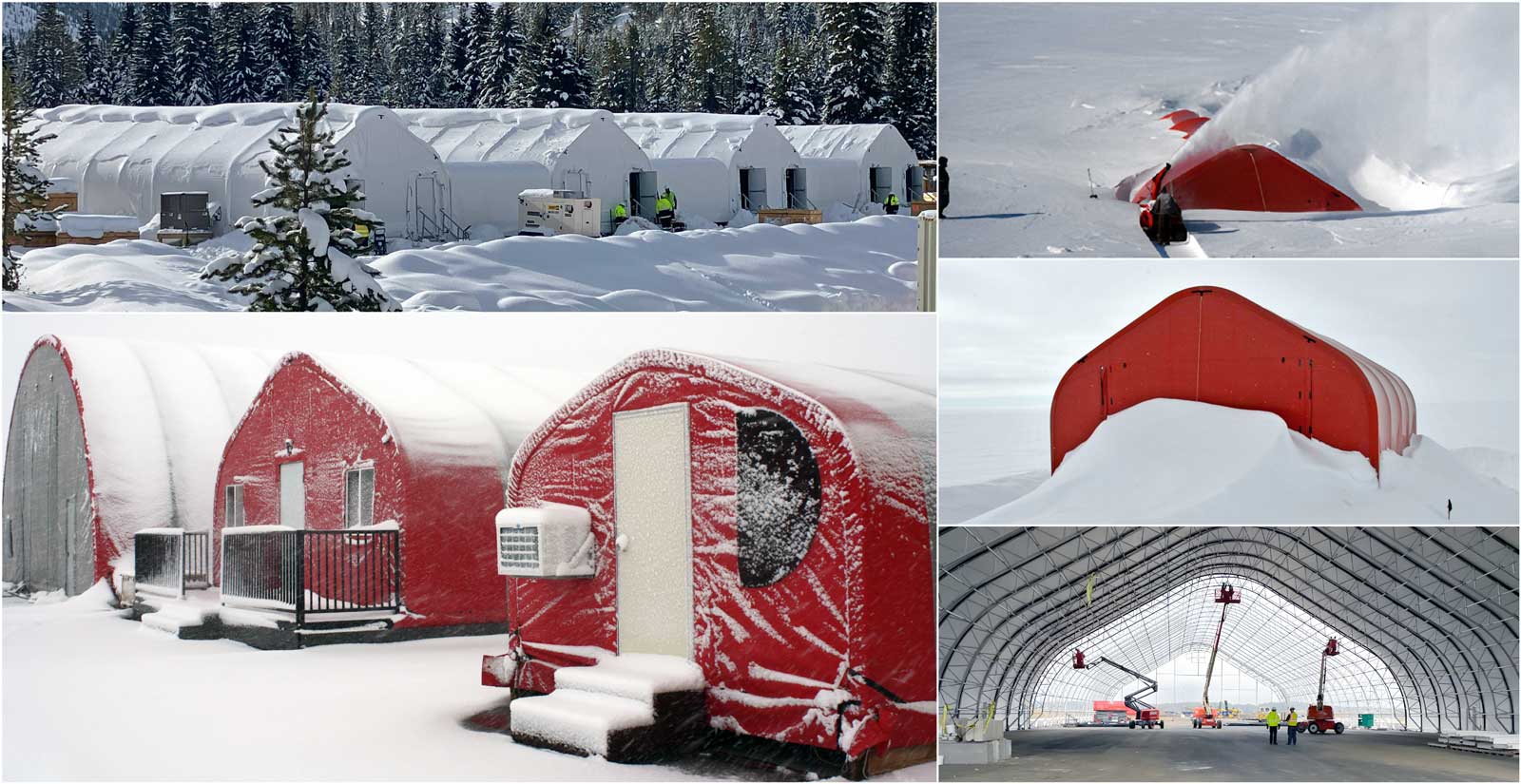
| Transport Efficiency | Highly efficient, bulk transportable systems. A single 53-foot flat-bed trailer can transport five insulated 24-foot by 60-foot HGB Series™ building systems from Alaska Structures®, capable of providing accommodations for 90 people (at 80 square feet per person). | Moderate. | A 53-foot flat-bed trailer can haul two 20-foot work site trailers, capable of sleeping a total of four people (based on 2-person sleeping units at 80 square feet of floor space per person). | Heavy and inefficient. | Heavy steel components. | Bulk materials required. | Extremely heavy materials. |
| Logistical Complexity | Low. | Moderate. | High. | High. | High. | Very high. | Extremely high. |
| Remote Deployment | Designed for remote and extreme environments. | Limited. | Logistically difficult. | Logistically complex. | Challenging. | Very difficult. | Impractical. |
| Site Preparation | Minimal. | Moderate. | Extensive. | Extensive. | Extensive. | Extensive. | Extensive. |
| Relocatability | Purposefully engineered for repeated setup and takedown cycles; can be disassembled and reinstalled by the owner or contractor without the need for manufacturer-provided supervision, while maintaining full warranty coverage. | Varies; some systems are designed for disassembly and relocation, but this often requires experienced personnel or manufacturer supervision to avoid compromising structural integrity or the warranty. | Difficult and costly. | Difficult and costly. | Difficult and costly. | Labor-intensive. | Not relocatable. Once built, a concrete building is there to stay. The logistics and costs to relocate a concrete building can quickly exceed the cost of constructing a new facility. |
| Thermal Efficiency | Proprietary insulation systems available to meet any R-value requirement; energy efficient by design. | Varies. | Insulated units, but compartmentalized layouts, multiple seams, and higher surface-area exposure reduce overall heating and cooling efficiency. | Poor — steel conducts heat and cold. | Poor without costly insulation. | Moderate. | Moderate. |
| Natural Lighting | Alaska Structures' fabric buildings can be designed with white fabric or translucent skylights to diffuse sunlight and create a bright interior, with little or no supplemental lighting required during the day. | Other fabric building providers also utilize white or translucent membrane materials, allowing natural daylight to reduce the need for supplemental lighting. | Limited natural lighting; typically rely on small windows and do not incorporate skylights due to structural, transport, and weatherproofing constraints. | Very limited natural lighting; typically rely on small cut-in windows. Skylights are uncommon due to structural modifications, water intrusion risk, and reduced container integrity. | Metal buildings are inherently dark and require significant artificial lighting or the installation of costly skylights or translucent panels to improve interior brightness. | Moderate natural lighting through windows; skylights can be added but increase cost, complexity, and potential for leaks. Interior brightness depends heavily on design and orientation. | Limited natural lighting without intentional design; requires windows, clerestory systems, or skylights, all of which add cost, complexity, and potential maintenance concerns. |
| Interior Space | Open-span interiors for maximum usable space. | Limited by design. | Compartmentalized with low ceiling heights. | Very limited space. | Obstructed layouts possible. | Varies. | Fixed layouts. |
| Acoustic Properties | By design, the tensioned fabric membranes of our prefabricated buildings are a great sound insulator. The acoustical properties can be further enhanced with optional insulation and liner packages for increasing comfort, energy efficiency, and a quieter interior living and working environment. | Acoustic performance depends on available insulation and liner systems. Some solutions offer basic sound reduction, but performance is typically limited compared to the insulation and acoustic packages available with engineered fabric buildings from Alaska Structures®. | Limited acoustic performance; thin wall assemblies and compartmentalized layouts allow sound transmission between units. Noise control can be improved with additional insulation, but is not typically optimized for acoustic comfort. | Poor acoustic performance; steel walls readily transmit and reflect sound, resulting in higher interior noise levels. Sound control requires added insulation and acoustic treatments, reducing usable interior space. | Metal buildings are made of hard surfaces that increase sound reflection and ambient noise levels. Acoustic performance can be improved with insulation and engineered sound-deadening systems, but this adds cost and complexity. | Can provide good acoustic performance when properly constructed with insulation, soundproofing materials, and quality windows; however, performance varies based on design, materials, and construction quality. | Hard, dense surfaces result in high sound reflection and echo. Acoustic performance can be improved with engineered sound treatments and insulation systems, but this increases cost and design complexity. |
| Durability in Extreme Environments | Proven in extreme climates worldwide. | Limited. | Moderate. | Limited. | Moderate. | Variable. | High but static. |
| Maintenance | Once installed, engineered fabric buildings from Alaska Structures® are virtually maintenance free. | Moderate maintenance requirements; lower-grade materials and reduced engineering can lead to more frequent inspections, adjustments, and replacement of fabric or structural components over time. | Moderate to high maintenance; requires ongoing upkeep of roofing, seals, HVAC systems, and structural connections between units. Frequent relocation and transport can accelerate wear and tear. | Moderate to high maintenance; steel construction is susceptible to corrosion, especially in harsh or coastal environments. Requires ongoing inspection, repainting, sealing, and maintenance of modified components. | Moderate to high maintenance; requires periodic inspection and upkeep of coatings, fasteners, and structural components to prevent corrosion, leaks, and degradation over time. | High maintenance; subject to moisture damage, warping, rot, pests, and material degradation. Requires ongoing inspection, repair, and replacement of structural and finish components. | Moderate maintenance; durable structure, but requires upkeep of joints, sealants, roofing systems, and repairs for cracking or environmental wear over time. |
| Scalability | Easily expandable. | Limited. | Difficult. | Limited. | Limited. | Difficult. | Not scalable. |
| Lifecycle Cost | Higher initial investment, but delivers a low total cost of ownership over 10–30+ years. Engineered for durability, minimal maintenance, rapid deployment, reduced foundation requirements, and full relocatability — allowing assets to be reused across multiple projects. Energy-efficient designs further reduce operational costs over the building lifecycle. | Moderate total cost of ownership; typically lower initial engineering and material specifications can result in increased maintenance, reduced lifespan, and earlier replacement of components or entire structure. Additional costs may include setup crews or technical advisors, foundation requirements, and limited reusability compared to fully engineered fabric buildings. | High total cost of ownership due to transportation inefficiencies, site preparation, setup logistics, and ongoing maintenance. Limited lifespan and difficulty in reuse across projects further increase long-term costs. | High total cost of ownership; significant costs associated with modification, insulation, transportation, and ongoing maintenance. Reduced interior efficiency and limited flexibility can further increase operational costs over time. | High total cost of ownership driven by extensive foundations, longer construction timelines, labor-intensive installation, and limited relocatability. Ongoing maintenance, including corrosion protection and insulation upgrades, adds to lifecycle costs. | High total cost of ownership due to labor-intensive construction, longer build times, ongoing maintenance, and susceptibility to environmental factors such as moisture, pests, and material degradation. | Very high total cost of ownership due to extensive site preparation, heavy equipment, long construction timelines, and permanent nature. Relocation is not feasible, and modifications or expansion can be costly and complex. |
Alaska Defense™ is now the military division of AKS Industries, Inc. You’ve
indicated your request is for a military requirement.
Please visit the Alaska Defense™ website (www.alaskadefense.com) for
military shelter systems and products.
SHARE YOUR CART