

Whether you are planning a new warehouse, workforce accommodation camp, maintenance facility, sports complex, manufacturing expansion, or temporary project infrastructure, selecting the right building system can significantly impact construction timelines, long-term operational costs, maintenance requirements, and overall project success.
For many organizations, the discovery process begins with a simple question: “What type of building is best for my project?”
The answer depends on a variety of factors, including:
- Project timeline
- Site accessibility
- Climate and environmental conditions
- Budget and lifecycle costs
- Relocatability requirements
- Building code requirements
- Interior clear-span requirements
- Future expansion plans
- Long-term operational needs
Today’s project owners and decision-makers have more options than ever before. Alongside traditional brick-and-mortar construction, engineered fabric buildings, pre-engineered metal buildings (PEMBs), modular trailers, containerized facilities, and other rapidly deployable building systems are now available.
Each solution offers advantages and limitations depending on the intended application.
UNDERSTANDING THE MAJOR BUILDING SYSTEM OPTIONS
Pre-Engineered Fabric Buildings (PEFBs)
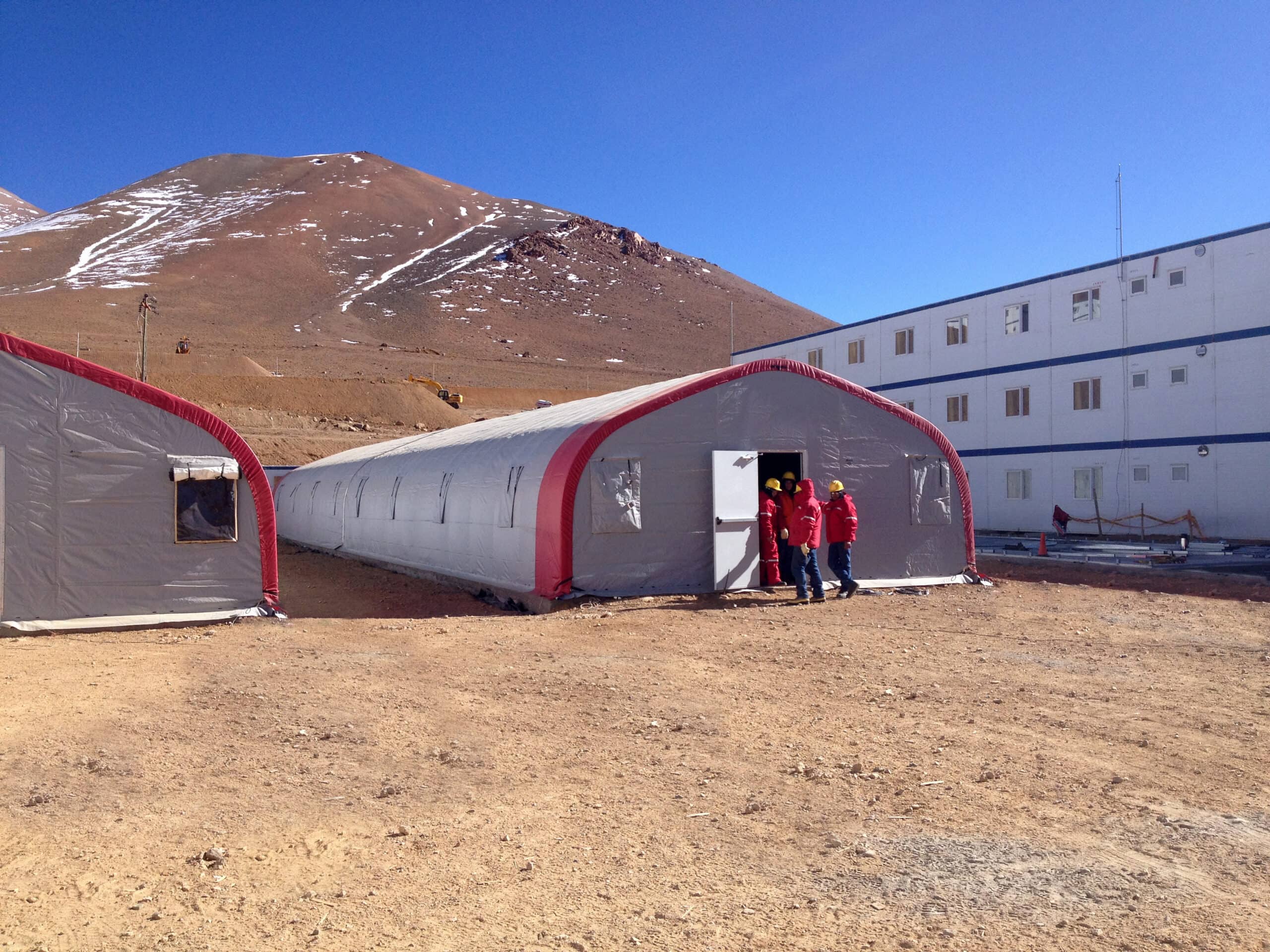
Pre-engineered fabric buildings combine a structural frame system with a tensioned fabric membrane to create large open-span interiors capable of supporting a wide range of applications.
While some fabric structures are intended for temporary or light-duty applications, fully engineered PEFB systems are designed to meet applicable building code requirements for wind and snow loads and are capable of long-term use in demanding environments.
Engineered fabric buildings are commonly used for:
- Warehousing and onsite storage facilities
- Aircraft hangars
- Vehicle and equipment maintenance facilities
- Manufacturing and fabrication expansion
- Drydock and marina facilities
- Mining camps and workforce accommodations
- Construction laydown facilities
- Onsite dining facilities
- Sports and aquatic facilities
- Event structures and stage covers
One of the primary advantages of engineered PEFB systems is their ability to provide large, clear-span interiors without internal support columns while also offering significantly faster installation timelines than conventional construction methods.
If performance, speed, and long-term reliability matter, pre-engineered fabric buildings (PEFBs) from Alaska Structures® deliver a superior alternative to trailers, containers, metal buildings, and conventional construction.
Other Fabric Structures
Not all fabric buildings are engineered equally.
Some fabric structures are designed primarily for temporary use and may rely on simplified engineering assumptions or lighter-duty frame systems. Performance, durability, and code compliance can vary significantly depending on the manufacturer and intended use.
For this reason, understanding the engineering behind a fabric building system is critical – especially in environments with significant wind, snow, or temperature extremes.
Pre-Engineered Metal Buildings
Pre-engineered metal buildings are widely used for industrial and commercial applications requiring permanent construction.
PEMBs offer durability and can support large building footprints. However, they typically require more extensive site preparation, foundations, heavy equipment, skilled installation crews, and longer construction timelines when compared to engineered fabric building systems.
Metal buildings can also require additional insulation and daylighting systems to improve interior comfort and energy efficiency.
Modular Trailers and Workforce Accommodations
Modular trailers and mobile office units are commonly used for workforce accommodations, temporary offices, classrooms, and remote camps.
These systems can be delivered largely pre-assembled, reducing onsite construction requirements. However, transportation logistics, road access requirements, utility connections, maneuvering space, and long-term scalability can become challenges—particularly in remote or difficult-to-access locations.
Containerized Buildings
Containerized facilities utilize ISO shipping container designs or purpose-built modular container systems to create relocatable structures.
These systems are often used for:
- Remote operations
- Utility infrastructure
- Equipment shelters
- Portable offices
- Communications facilities
- Specialized industrial applications
Purpose-built containerized systems can deliver highly engineered, durable solutions for specific applications. However, interior space limitations, thermal transfer through steel construction, transportation logistics, and long-term scalability can create limitations depending on the project.
Conventional Construction
Conventional construction methods—including wood-framed buildings, concrete tilt-up construction, and brick-and-mortar facilities—continue to play an important role in permanent infrastructure development.
These systems can provide highly customized and architecturally integrated facilities, but often involve:
- Longer construction timelines
- Extensive site preparation
- Larger labor requirements
- Significant foundation work
- Greater dependency on weather conditions during construction
- Higher long-term relocation costs
For temporary, seasonal, or rapidly changing operational requirements, conventional construction methods may not always provide the greatest flexibility.
COMPARE BUILDING SYSTEMS SIDE-BY-SIDE
Still evaluating which building solution is best suited for your project? Explore our Building Comparison Matrix to compare engineered fabric buildings against modular trailers, containerized facilities, pre-engineered metal buildings (PEMBs), wood-framed construction, concrete tilt-up construction, and conventional brick-and-mortar buildings.
The comparison includes engineering, installation timelines, relocatability, lifecycle costs, foundation requirements, environmental performance, maintenance, and other important considerations that can impact long-term project success.
CONTINUE YOUR BUILDING RESEARCH JOURNEY
Choosing the right building system is often a process that evolves as project requirements become more defined.
To assist project owners and decision makers during the discovery and evaluation process, Alaska Structures® has developed additional resources covering engineering, materials, construction considerations, and long-term performance.
Explore the Building Comparison Matrix
Review the complete side-by-side comparison of PEFBs, metal buildings, modular trailers, containerized systems, and conventional construction methods.
Learn What to Consider Before Buying a Fabric Building
Understand key considerations such as engineering, materials, installation requirements, environmental performance, and lifecycle costs.
Learn More About Engineered Fabric Buildings
Discover how engineered fabric buildings differ from other fabric structures and explore the advantages of PEFB systems.
Why Choose Fabric Buildings from Alaska Structures®
Explore the engineering, materials, manufacturing processes, and long-term performance advantages behind Alaska Structures® building systems.